1500F
1500F is a normal budget for food per day in Dakar. You can eat for less, but with 1500F (US$2.60) you know you can be satisfied. That’s what this average Dakarois told me. Like many others, that’s someone who comes from outside Dakar and doesn’t have a kitchen. (Kind of someone like me?) My Dakarois explains:
- breakfast 300F (US$0.50), coffee with milk, bread,
- for lunch 700F (US$1.20), a meal in a gargote.
- dinner 500F (US$0.90), some sort of porridge with soured milk.
So I give it a go.
Breakfast wasn’t difficult, but I usually don’t eat much for breakfast. Coffee, and when I did eat, bread and butter. Probably less than 300F.
I never found the gargote meal for 700F. I got a Thieboudienne for 1000F, but needed to add 100F to take it away. A good portion of tomato-stewed broken rice, small bits of vegetables, served with a bare hand, most very known to Europeans: carrot, turnip, cabbage, and some less like African eggplant. Some “fresh” fish, maybe not so fresh, and some fermented fish and mollusc; wow fishy! Some chili sauce, and some other sauce with peanut I think. Good, really glad to have a few vegetables, but I must say that I didn’t finish the fermented mollusc. My belly was fine in case you wonder; many of my Senegalese acquaintances were shocked that I’d eat this kind of food, they wouldn’t. In my experiment, I also made my own food. I bought simple ingredients and prepared simple meals. A large can of chickpeas (800g) gives 2 fulfilling meals, 1400F. Add some local avocado, a huge one costs 300F, a bit of fresh onion, oil, salt, vinegar, spices and eat with bread. It tasted really nice and I was glad to have some vegetables.
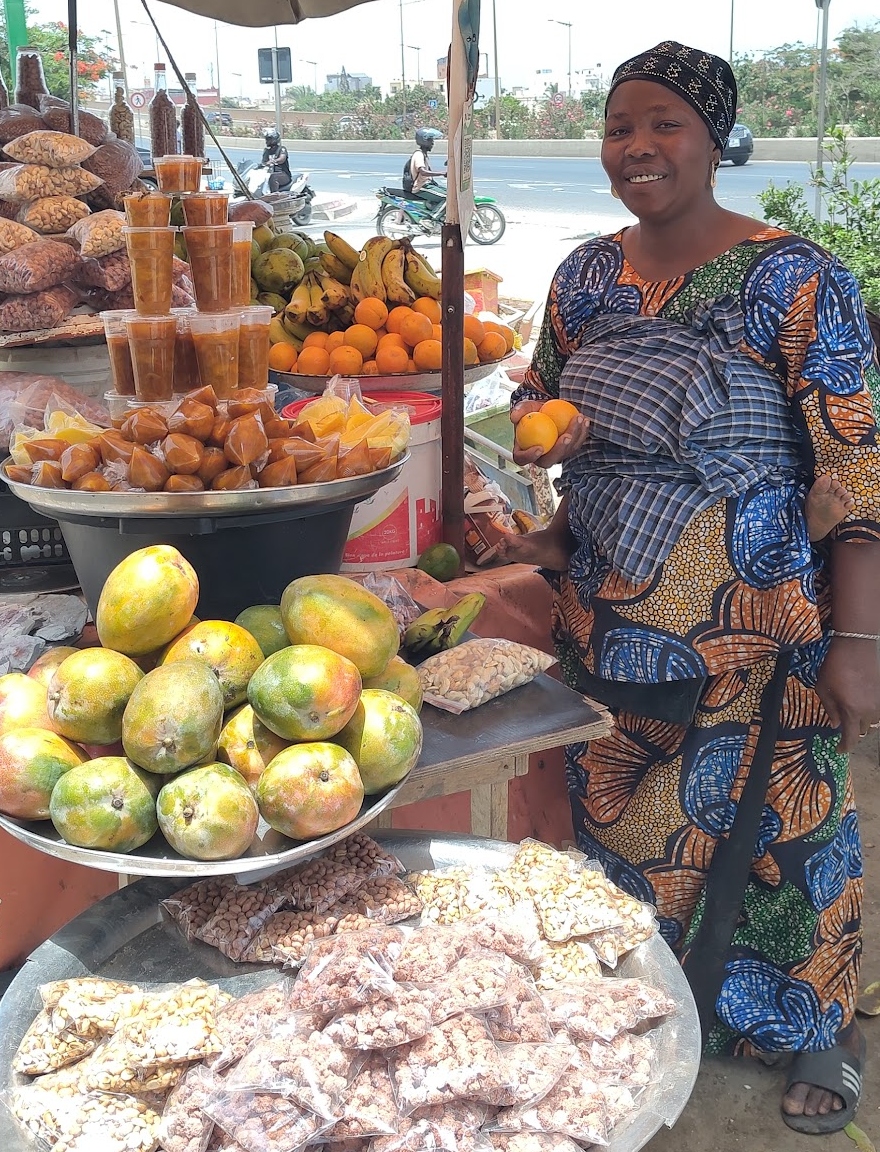
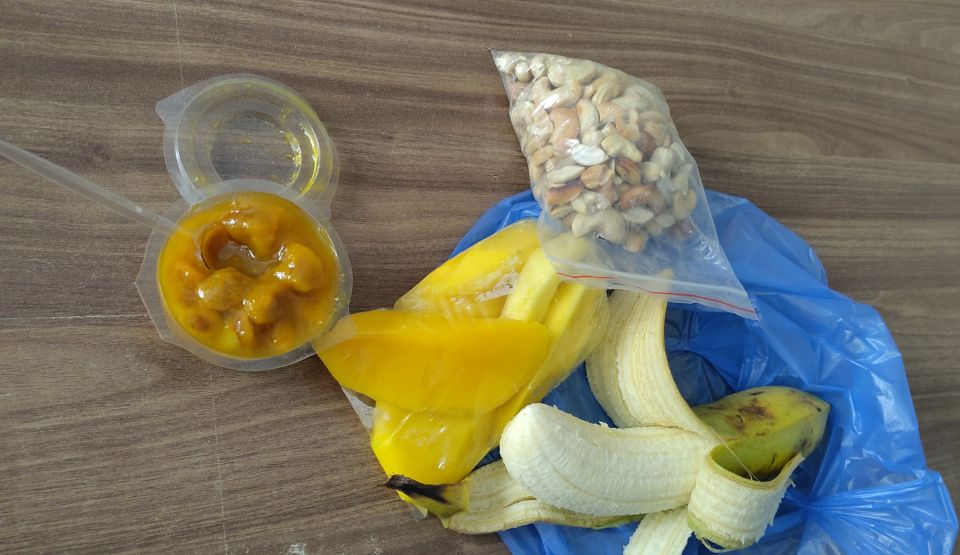
I had many snacks like mangoes and peanuts. I found that buying pre-cut mangos was a good deal: 100F for half a mango. There are 2 kinds: the soft juicy and sweet ones. Some slightly crunchier ones that are eaten with salt and chilli. A small bag of freshly roasted peanuts is 50F that’s also a good deal, and all the peanut roasters are usually very friendly older ladies.
In the evening, I know that there are some old serer ladies selling millet porridge. They actually set up shop very late; and it’s actually a bit stressful for me to buy something. There’s a line, they want to sell fast, they don’t speak French, except prices. From previous times, I remember that you tell them how much you want in monetary amount. 100F of this, 100F of that, and 100F of that. Thiakry, Fondé or Thiéré, any of those things is quite filling for 100F. It’s quite bland. Some are eaten with soured milk, and some with milk. And in all cases, sugar is added. I found some fresh soured milk, not made with powdered milk to have with my Fondé. A large pot of 1kg is 1200F and can be used a few times. I found some fresh milk to eat with Thiéré. That milk is strange; I’m confident it’s really fine to drink, but it’s kind of foamy. I try some, I don’t know how to describe it, it's very different to what I know. A lot fatter. Maybe less taste than the milk I know? and more “consistency”. In a future episode, I see the cows that give this milk and understand why it has nothing to do with the milk I know.
Overall, the experiment wasn’t so difficult to follow. I managed for ~4 days. When paying attention, $2.60 is totally feasible. But it might be possible to eat for that much or less in Europe. Food is pretty expensive in Dakar. It was a useful exercise to put things in perspective. It’s easy to slip into a sort of belief that living in Dakar makes you feel what it’s like for the average person. But, I had a decent place to sleep and wash. I didn’t have to do manual labor. And I didn’t try living without air condition; that last one would be really hard. What was interesting about the experiment was the "paying attention" bit. Now, I have money in perspective: a short taxi ride that’s 1500F, or a long one 2500F. I thought these were a bargain. Then I got some coffee from a nice café for 3000F. A brunch with a sea view 14000F. It’s easy to spend as much as in Europe, these places are totally out of bounds for normal people.
And... 1500F per day is still a large portion of an average budget; probably half of what my Dakarois friend earns a day.